New Zealand Native Bees: Who They Are and How to Help Them
Our 28 native bees are small, solitary and harmless. You cannot hive them, but you can make your garden a place they thrive.
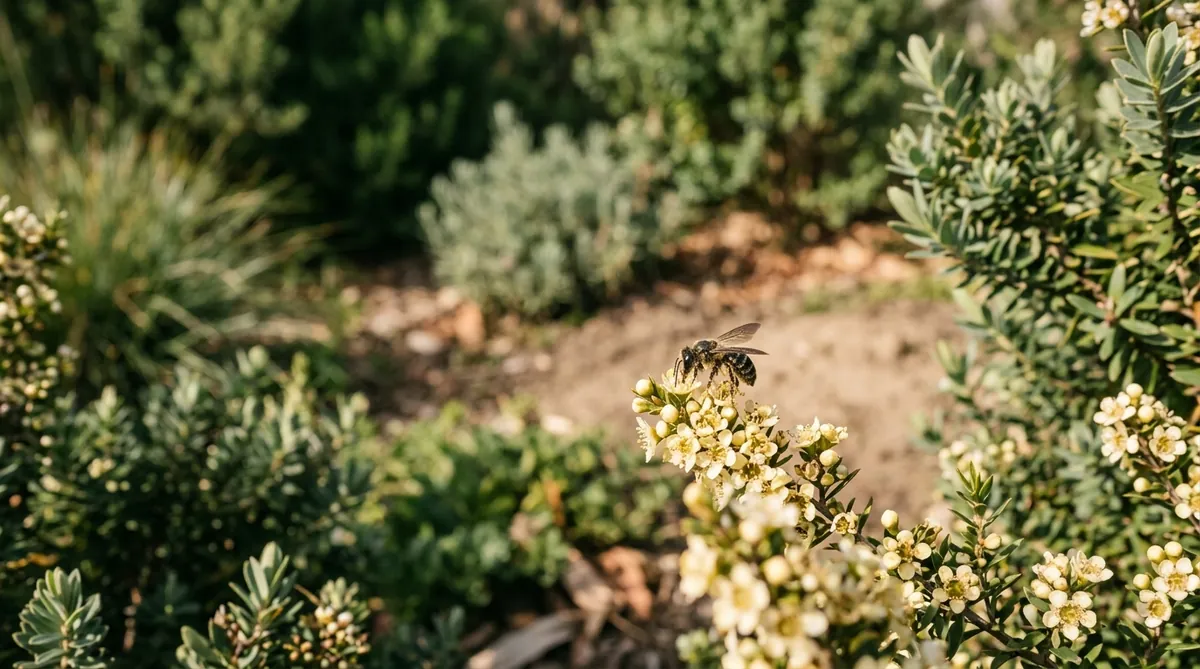
New Zealand has 28 species of native bee across three groups (Leioproctus, Lasioglossum and Hylaeus). Every one is solitary, harmless and lives apart, not in a hive. Unlike Australia's social stingless bees, there is no colony or box to buy here. What you can do is give them food and somewhere to nest, and they will find you.
Meet the locals
You will likely walk past most of them without noticing, because they are tiny and quiet. The three groups are:
- Leioproctus (ngaro huruhuru): the largest and most common, 5-12mm, dark and noticeably hairy. Each female digs a nest tunnel up to 30cm into bare, well-drained soil.
- Lasioglossum: the smallest at 4-8mm, nearly ant-sized, black or faintly greenish. Also ground-nesters, and several females will sometimes share one entrance.
- Hylaeus (masked bees): slender and almost hairless with a lemon-yellow face. The only group that nests above ground, in hollow stems and old beetle holes.
They are busiest from late spring through summer, and they are among the most important pollinators of our native plants. Not sure what you are looking at? Use the bee identifier to tell natives from honey bees, bumblebees and wasps.
You cannot keep them, but you can host them
There is no New Zealand version of the Australian stingless-bee box. Our native bees are solitary, so there is no colony to buy and nothing to manage. Helping them is about habitat, not hives, and it costs nothing.
Make your garden a native-bee haven
- Leave bare, sunny soil. A few undisturbed, north-facing patches of bare ground give the ground-nesters somewhere to dig. Mulching every square centimetre leaves them nowhere to go.
- Stand up some hollow stems. Leave dead flax flower stalks, bundle hollow canes, or drill 4-8mm holes in untreated timber for the masked bees. That is the New Zealand version of a "bee hotel".
- Flower across the seasons. They do not travel far, so keep something in bloom close by. Borage, alyssum and small open flowers are easy wins, alongside native shrubs.
- Stop spraying. Even organic sprays kill bees on contact. If you must spray, do it at dusk when bees are not flying.
What to plant, flock and hive jobs for the month, in one short email. No spam.
Unsubscribe any time.