
Updated October 2026
Making Apple Cider Vinegar in New Zealand
Hawke's Bay and Nelson grow most of the country's apples, and a home tree gives plenty for vinegar. Here is how, and what not to use it for.
Homemade cider vinegar is apple juice fermented first to alcohol, then to acetic acid, with air reaching it through a cloth cover. Keep it at 16 to 27°C, stir it daily, and it is usually sour within a month or so. It makes a fine dressing and marinade vinegar. Because its strength is never known, it is not safe for bottled chutneys or pantry pickles: use bought vinegar of 5% acidity for those.
Sugar for a scrap batch
Scrap Vinegar Calculator
Making vinegar from apple scraps? Enter how many cups of water you are using and this works out roughly how much sugar to dissolve in it for stage one. The rule of thumb is about 1 tablespoon of sugar per cup of water.
This is a kitchen rule of thumb for scrap vinegar, not a tested recipe: about 1 tablespoon of sugar per cup of water, or 50 g per litre. Fill the jar half to two thirds with scraps and cover them with the sweetened water.
The method
Choose sweet apples. Late season apples carry the most sugar. Braeburn, Royal Gala and Fuji, all common in New Zealand orchards and backyards, work well; very green, early apples may not have enough sugar.
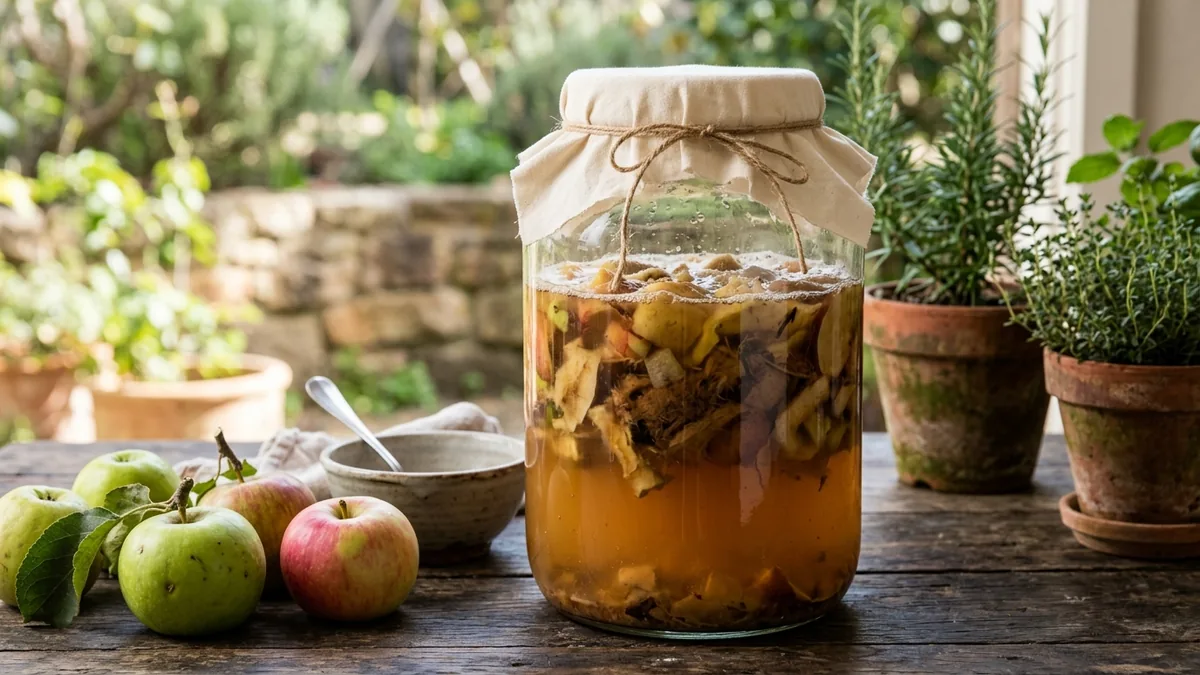
Juice or scraps. Press and strain apples for juice, or half fill a wide jar with cores and peels and cover them with sweetened water.
Air, not a lid. Cover with cheesecloth and a rubber band. Stir daily so air reaches the liquid.
Temperature. Penn State Extension gives 16 to 27°C. An unheated New Zealand kitchen in late autumn can drop below that, and a cool batch may never turn to vinegar, so a warm hot water cupboard shelf can help.
Finish. Taste once it smells of vinegar. When it is sour enough, filter out the mother through a coffee filter and bottle it.
Ferment in glass, enamel, food-grade plastic or stainless steel; acid corrodes other metals.
Mother versus mould
The mother is a rubbery, translucent sheet that grows across the top or sinks to the bottom, cream to light brown, and the jar smells sharply of vinegar. That is the bacteria at work, and it is harmless. Mould grows as raised, furry dots in white, green, blue, black or pink, often with a stale or rotten smell. If you see mould, tip out the whole batch and wash the jar; skimming it off is not enough.
Storing it
To stop it fermenting further, pasteurise it: heat to between 60 and 71°C and pour into sterilised bottles. Keep it out of the sun, which fades the colour and flavour.
What to use it for
Dressings, marinades, sauces and fridge pickles. Not bottled preserves, and not pickles stored in the pantry. New Zealand vinegar sold in shops only has to be 4% acetic acid, so even bought vinegar needs its label checked before pickling.
See also: Preserving the Harvest and pickling.
Sources we checked (October 2026): Penn State Extension, Making Cider Vinegar at Home; Food Standards Code Standard 2.10.1 Vinegar and related products; USDA Complete Guide to Home Canning (2015) through the National Center for Home Food Preservation, General Information on Pickling.
Common questions
Can I pickle with my homemade vinegar?
Only fridge or freezer pickles. For anything bottled or stored in the pantry, use bought vinegar labelled 5% acidity.
Which apples make the best vinegar?
Sweet, late season apples. Very green early apples may not have enough sugar to ferment well.
Why has my vinegar stopped?
Usually it is too cold or short of air. Keep it between 16 and 27°C, covered with cloth, and stir daily.