
Updated October 2026
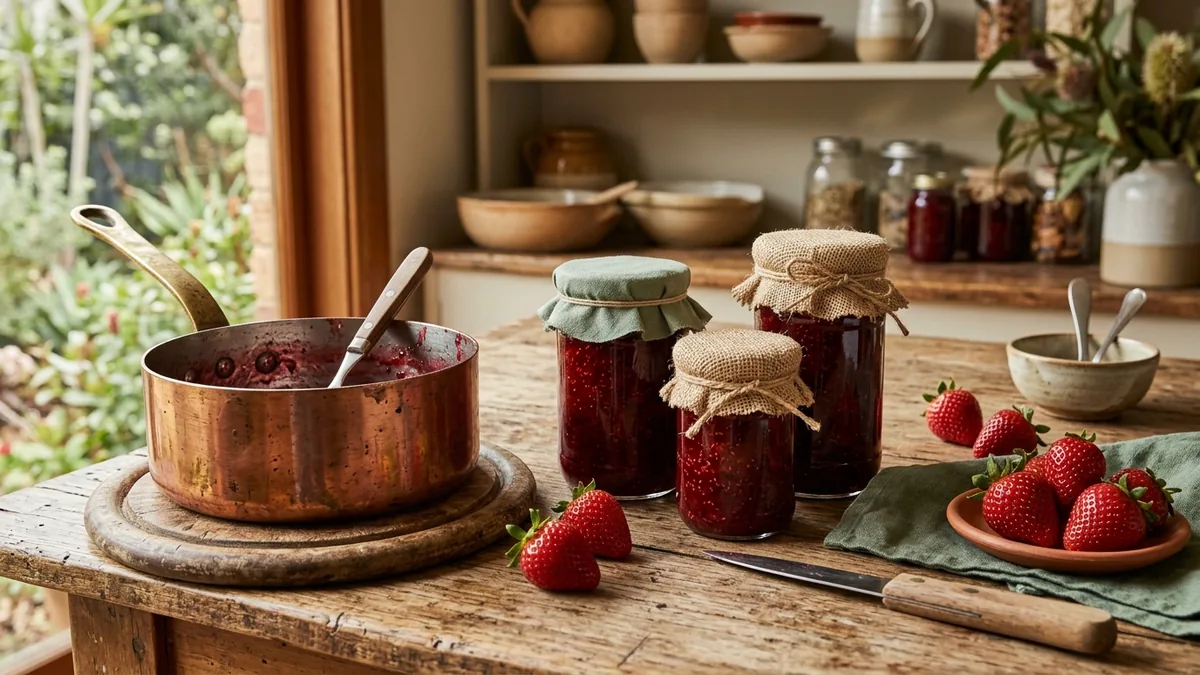
Making Jam in New Zealand: Setting Point, Jars and Safe Sealing
The overflow method fills and seals jam hot with no further heating. A 5 minute boil after filling is the tested way to keep jam in the pantry.
Make jam with the full amount of sugar, cook it to the set, then fill sterilised jars to 6 mm from the top and boil the sealed jars for 5 minutes. Many Kiwi cookbooks teach overflow bottling for jam, where hot jam fills the jar to the brim and the lid goes straight on. It often works, but it is not a tested method, and the USDA (the only body that has tested home jam processing) processes every jam, jelly and marmalade in boiling water after filling to stop moulds.
Batch calculator
Jam Batch Calculator
These are estimates. Real yield varies with how juicy the fruit is and how long you boil it, so keep a spare clean jar handy.
Set: sugar, pectin and acid
A jam sets when pectin, acid and sugar meet in the right proportions. Apples, quinces, gooseberries and many plums bring plenty of pectin, so a late summer batch of Black Doris plums often needs little help. Strawberries and cherries bring very little and need lemon juice with added pectin, or jam setting sugar. For autumn feijoa jam, follow a recipe that gives its pectin and sugar amounts.
Keep the sugar at the level the recipe gives. USDA says cutting it in a traditional recipe weakens the gel and invites mould and yeast. If you want a lighter jam, choose a recipe made for a reduced-sugar pectin and use the processing time printed with it.
Three ways to tell it is ready
Temperature. Jam is ready at about 104.5°C at sea level, 4.5°C above boiling. Almost every New Zealand kitchen is low enough to use that figure. In Taupō or the Mackenzie Basin take off about 1°C for every 300 m of height.
Saucer. Chill a few saucers in the freezer. Pull the pan off the heat, put a little jam on a saucer and push it after a minute. A wrinkled skin means it has set.
Spoon. When the jam runs off a cold spoon in a single sheet rather than drops, it is done.
Filling, sealing and processing
| Step | What to do |
|---|---|
| Sterilise jars | Boil them covered in water for 10 minutes, or skip this and process the filled jars for 10 minutes instead of 5 |
| Fill | Hot jam, 6 mm headspace, rims wiped clean |
| Seal | New two-piece self-sealing lids. Agee preserving jars with new lids and bands suit this; reused lug lids from bought jars were not part of the testing |
| Process | 2.5 cm of water over the jars at a full boil: 5 minutes up to 300 m above sea level, 10 minutes above that |
| Check | After 12 to 24 hours, any lid that still flexes goes in the fridge and is eaten first |
Paraffin wax tops are no longer recommended, and inverting jars does not replace processing.
Marmalade, the New Zealand way
Poorman oranges, the classic New Zealand grapefruit, ripen through winter and spring and make a sharp, well-set marmalade. Seville oranges, lemons and limes all work too. Shred the peel, keep some of the white pith (it holds the pectin), and simmer the peel in water for about 30 minutes until it is soft before any sugar goes in. Then add the fruit and sugar, boil to the set and process as above.
Fridge and freezer jams
Gelatin-set jams made with sugar substitutes must stay in the fridge and be eaten within a month (USDA). Uncooked berry jams set with pectin keep up to 3 weeks in the fridge or a year in the freezer. Left in the pantry they will ferment.
Problems and fixes
Runny jam was short of pectin or acid, or came off the heat too soon; remake it a small batch at a time with added pectin. Stiff jam was overcooked. Crystals mean the sugar was not fully dissolved before the hard boil. Mould on top means the whole jar goes in the bin: USDA notes jam mould can produce mycotoxins, so do not scrape it off and eat the rest.
Store sealed jars somewhere cool and dark and use them within a year. Once open, keep jam in the fridge.
Sources we checked (October 2026): USDA Complete Guide to Home Canning (2015) and So Easy to Preserve (University of Georgia, 6th ed.) through the National Center for Home Food Preservation: General Information on Canning Jams, Jellies and Marmalades, Berry Jams without Pectin, Berry Jam (Uncooked), Citrus Marmalade, Testing Jelly without Added Pectin, Sterilization of Empty Jars, Equipment and Methods Not Recommended; New Zealand Food Safety (MPI), Clostridium botulinum or botulism.
Common questions
Is the overflow method safe for jam?
It is traditional, not tested. USDA's tested method fills hot jam into sterilised jars and then boils the sealed jars for 5 minutes, which stops moulds forming under the lid.
What temperature does jam set at?
About 104.5°C at sea level, or 4.5°C above the temperature your water boils at. Confirm with the cold saucer test.
Can I make feijoa jam?
Yes. Use a recipe that gives its pectin and sugar amounts, and process the jars the same way as any other jam.
Can I use less sugar?
Only with a recipe written for a reduced-sugar pectin, processed for the time on the packet, or as a fridge or freezer jam.
Is mouldy jam safe if I scrape it off?
No. Throw the whole jar out, because mould on jam can carry mycotoxins.