
Updated October 2026
Brewing Kombucha in New Zealand: A Safer Method
New Zealand has no official home kombucha guide, so we follow the tested US recipe and the safety checkpoints Australian food safety advice adds.
Use a tested recipe: per 3.8 litres of water, 6 black tea bags (or 13 green), about 200 g of sugar, and a SCOBY with starter liquid at pH 4.0 or lower. Ferment it at 20 to 25°C for 7 to 10 days, then refrigerate it and drink it within 30 days. That is the National Center for Home Food Preservation's tested method. Australia's Food Safety Information Council adds a check worth borrowing: the finished brew should test below pH 3.0, and a batch that has not reached it by day 10 should be thrown out.
How much to brew
Kombucha Batch Calculator
Enter your finished batch size in litres and we will work out the tea, sugar and starter tea to begin.
Please enter a batch size greater than zero.
| Black tea | |
| White sugar | |
| Starter tea (mature kombucha) | |
| SCOBY |
Scaled from the NCHFP tested recipe (black tea version): per 3.8 litres, 6 black tea bags, about 200 g sugar, and a SCOBY with its starter liquid at pH 4.0 or lower.
The method
Sanitise first. Wash the jar and tools, then hold them in water of at least 77°C for 30 seconds.
Tea. Heat 1 litre of the water to 71 to 77°C, steep the tea for 2 minutes, remove it and dissolve the sugar. Add the rest of the water cold.
Cool, then culture. The tea must be below 35°C before the SCOBY goes in. Test the starter liquid; if it is above pH 4.0, do not use it.
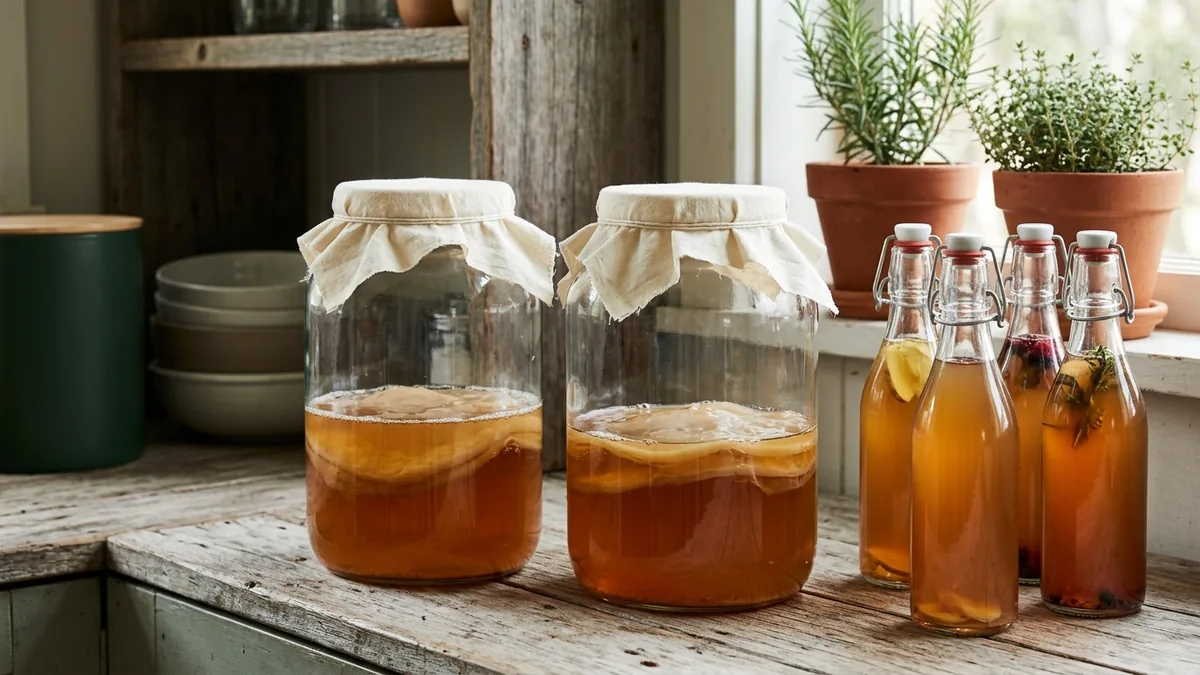
Ferment. Cover with a cloth and keep it at 20 to 25°C. In a New Zealand winter, most kitchens drop below that overnight, and a slow, cool ferment acidifies too slowly to protect itself; a warm spot or a heat mat helps.
Finish. Bottle it, refrigerate at 2 to 5°C and use within 30 days. Flavoured kombucha should be drunk straight away or kept in the fridge for no more than 2 days.
Safety checks
- Glass or stainless steel only; acid can draw lead from ceramic glazes.
- Fuzzy, dry patches on the SCOBY or the surface mean mould: discard the brew and the SCOBY.
- Sealed bottles of live kombucha build carbon dioxide and can burst; keep them cold and open them carefully.
- About 120 ml a day is the amount US extension research considers safe for most healthy adults; Australian advice says no more than 125 ml.
- Not recommended for anyone pregnant or breastfeeding, or with weakened immunity.
Kefir
Water kefir has no tested home method that we could find, so we do not give one. Milk kefir should only ever be made with pasteurised milk; New Zealand Food Safety warns that raw milk can carry harmful bacteria.
Sources we checked (October 2026): National Center for Home Food Preservation, Kombucha Tea; University of Georgia Extension, What's the Word on Homemade Kombucha? (2026); Food Safety Information Council (Australia), Kombucha; New Zealand Food Safety (MPI), Safe food preparation, cooking and storage at home.
Common questions
Is there New Zealand advice on home kombucha?
New Zealand Food Safety has no home brewing guide. We follow the tested US recipe and the Australian Food Safety Information Council's pH checkpoint.
Why did my kombucha go mouldy?
Usually a cold ferment, a weak starter or contamination. Mould means the tea and SCOBY both go. Keep it at 20 to 25°C and start with starter liquid at pH 4.0 or lower.
How long does homemade kombucha keep?
Use it within 30 days, kept in the fridge.