
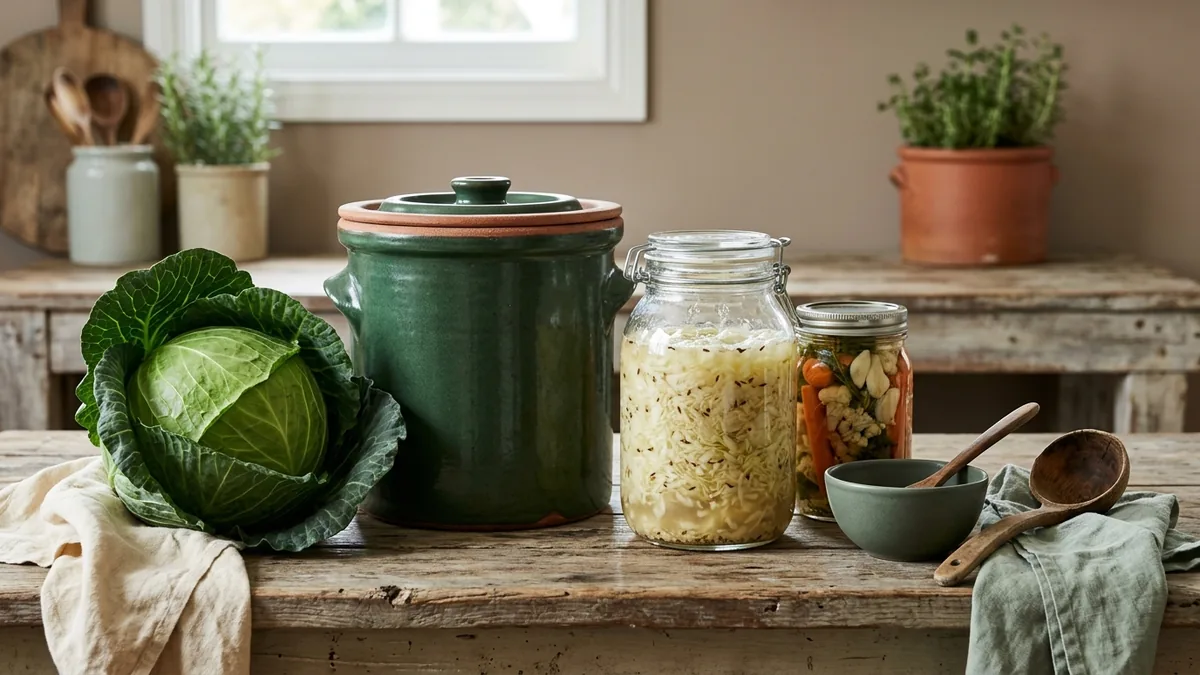
Updated October 2026
Making Sauerkraut in New Zealand: A Tested Method
A winter cabbage, pickling salt and a cool hallway cupboard. Here is the USDA-tested method, in metric.
Sauerkraut needs only cabbage and salt, but the ratio and the temperature decide whether it turns out right. The tested amount is 3 tablespoons (45 ml) of pickling salt for every 2.25 kg of shredded cabbage, fermented 3 to 4 weeks at 21 to 24°C, or 5 to 6 weeks at 16 to 18°C. Below about 15°C it may not ferment at all, which matters in a New Zealand winter more than the summer heat does.
Work out your salt
The calculator gives the salt for any weight of cabbage. The USDA amount is roughly 2.25 to 2.5% of the cabbage weight with fine pickling salt; the 2% setting is less than that.
Weigh the salt. Use pickling salt or fine non-iodised cooking salt; flaked salt does not measure evenly.
The method
Shred. Start within a day or two of cutting the cabbage. Take off the outer leaves, quarter it, cut out the core and slice it thin.
Salt and pack. Working about 2.25 kg at a time, toss the cabbage with its salt, then press it hard into a clean jar or crock until liquid rises over it. Repeat until the container is full to within 10 to 12 cm of the rim.
Weigh it down. The cabbage has to stay 2.5 to 5 cm under the brine. Use a plate held down with jars of water, or a sealed food-grade bag of salty water, which will not water down the kraut if it leaks. If there is not enough juice, top up with brine made from 1½ tablespoons (22 ml) of salt per 950 ml of boiled, cooled water.
Wait. Cover with a clean towel. Check two or three times a week, skimming off any surface scum, unless you used a brine bag, in which case leave it closed until it stops bubbling.
Finding the right spot
Most New Zealand houses in late autumn and winter, when the cabbages are ready, sit below the ideal 21 to 24°C. A hot water cupboard is often the warmest steady place in the house; check it with a thermometer, because above 24°C the kraut can soften. In an unheated room in Southland or Central Otago in July the ferment may stall. Expect 5 to 6 weeks in a room of 16 to 18°C.
What can go wrong
- White film: common surface yeast. Skim it off.
- Mould: remove it promptly. If it covers the surface or has grown into the cabbage, throw the batch out.
- Soft, slimy, dark or rotten-smelling kraut: spoiled. Throw it out; do not taste it.
- Not sour after six weeks: usually too cold, or the cabbage was not fresh.
Sauerkraut and fermented dill cucumbers are the only vegetable ferments USDA has tested. Kimchi and brined vegetables are widely made, but we have not found a tested method from a food safety agency, so we do not publish recipes for them. New Zealand Food Safety asks for extra care with fermented, smoked or salted meat and fish, which we leave to professionals.
Keeping it
Finished kraut keeps for several months covered in the fridge. For the pantry, heat it slowly to boiling with its juice, fill jars leaving 1.25 cm headspace and process in boiling water: 10 minutes for jars up to 473 ml, 15 minutes up to 946 ml. Processed kraut no longer has live bacteria.
Sources we checked (October 2026): New Zealand Food Safety (MPI), Clostridium botulinum or botulism; USDA Complete Guide to Home Canning (2015) through the National Center for Home Food Preservation: Sauerkraut, General Information on Fermenting, Suitable Containers, Covers and Weights for Fermenting Food, Causes and Possible Solutions for Problems with Fermented Pickles.
Common questions
Is it too cold to make sauerkraut in winter?
Below about 15°C kraut may not ferment. Find a spot between 16 and 24°C, such as a warm cupboard, and allow 3 to 6 weeks.
Can I use iodised salt?
USDA says iodised salt is safe, but anti-caking agents can cloud the brine. Pickling salt or plain non-iodised salt is better. Flaky salt does not measure evenly.
Do I need a starter culture?
Not for sauerkraut; the bacteria on fresh cabbage do the work. The tested method relies on the right salt and temperature.
How long does sauerkraut keep in the fridge?
Several months in a covered container once fully fermented.