
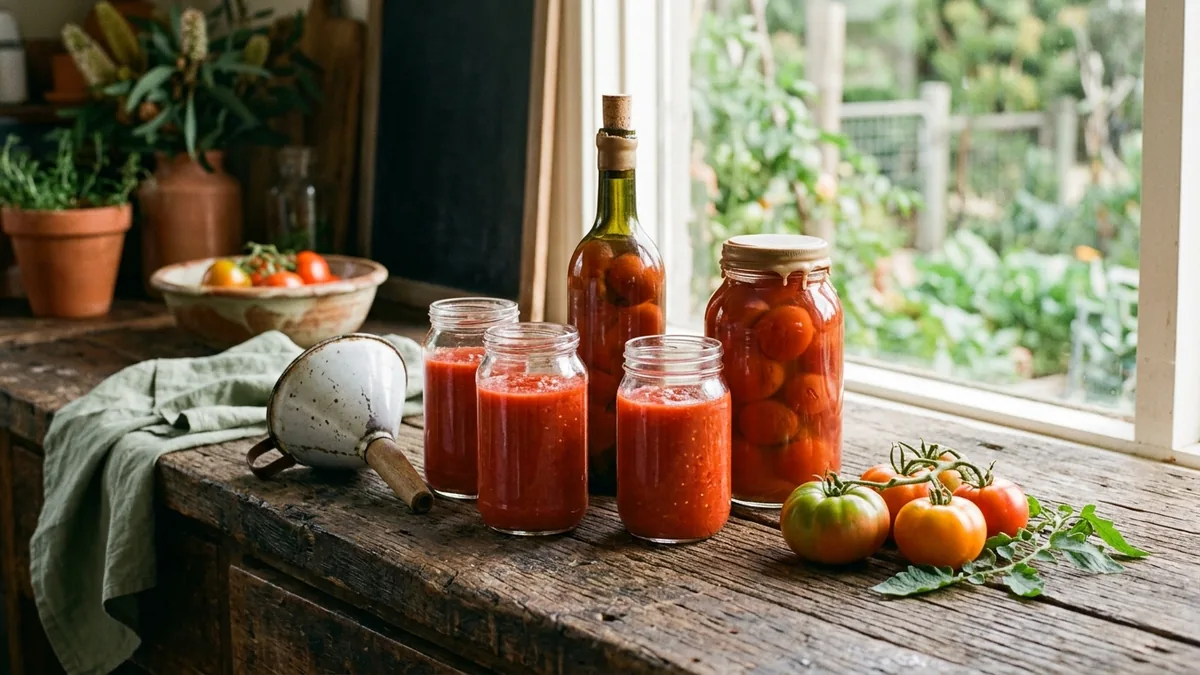
Bottling Passata in New Zealand: Acid, Times and Jar Sizes
Updated October 2026
Overflow bottling is not a tested method for tomatoes. Add acid, process the jars in boiling water for the tested time, and keep to jars of 946 ml or less.
Make passata the way Italian families do, by sieving cooked tomatoes, then put measured bottled lemon juice or citric acid in each jar and process the filled jars in a boiling water bath for 35 to 40 minutes. Tomatoes sit close to the acid line for botulism, so the acid is not optional, and the overflow method many New Zealand recipe books use (filling hot jars and sealing them without boiling) has no tested time for tomatoes. The figures here are the USDA's tested times for sieved tomato juice and sauce.
How much passata will your tomatoes make?
Acid for each jar
New Zealand tablespoons hold 15 ml, the same as the American spoons the tested amounts use, but we give millilitres to be clear.
| Jar | Bottled lemon juice | or citric acid |
|---|---|---|
| Up to 473 ml (a US pint) | 15 ml (1 tablespoon) | 1/4 teaspoon |
| 474 to 946 ml (most 500 ml and 750 ml preserving jars) | 30 ml (2 tablespoons) | 1/2 teaspoon |
| Over 946 ml, including 1 litre Agee jars | No tested time. Use smaller jars, or freeze. | |
Bottled lemon juice has a set acidity; a lemon off the tree does not. Citric acid is sold with the baking supplies in most supermarkets.
Step by step
Cook fast. Wash and core the tomatoes. Quarter a few into a large pot and heat them to a hard boil, crushing them as they go in, then keep adding quarters so the boil never stops. Give them 5 minutes once the last ones are in. Heating this fast is what stops passata splitting into a watery layer.
Sieve. Pass everything through a mouli or a fine sieve and throw out the skins and seeds.
Fill. Add the acid to each clean jar, and salt if you want it. Bring the passata back to the boil and ladle it in, leaving 1.25 cm of space at the top (6 mm if you reduced it to a thick sauce). Free any air bubbles with a clean spatula, wipe the rim and fit the lid and band.
Process. Lower the jars onto a rack in a deep pot and cover them with at least 5 cm of water. Bring it to a rolling boil with the lid on, then start timing.
| Height above sea level | Jars up to 473 ml | Jars 474 to 946 ml |
|---|---|---|
| Up to 300 m | 35 minutes | 40 minutes |
| 301 to 900 m | 40 minutes | 45 minutes |
Nearly every New Zealand town is in the first row. Taupō, Ohakune, Tekapo and Twizel are among the places in the second. If the water stops boiling at any point, bring it back up and time the whole process again.
Cool. Turn off the heat, lift the lid off the pot and wait 5 minutes. Move the jars to a tea towel with a gap between each one and leave them alone for 12 to 24 hours before you check the seals.
When the glut comes
Northland and Auckland gardens usually have ripe tomatoes from January; Canterbury, Otago and Southland come in later and peak around March. A greenhouse in the south brings that forward. See our tomato growing guide for your region's planting window.
Storage and safety checks
Store sealed jars without the bands in a cool, dark cupboard and use them within a year. USDA's storage range is 10 to 21°C, never above 35°C. Once a jar is open, keep it in the fridge (New Zealand Food Safety recommends 2 to 5°C) and use it within a few days.
A lid that has not sealed within 24 hours can have a new lid fitted and be processed again for the full time, or go in the fridge to be used within a week. New Zealand Food Safety says to throw away any preserved food that is bulging, badly damaged or looks spoiled. Do not taste it first.
Sources we checked (October 2026): New Zealand Food Safety (MPI), Clostridium botulinum or botulism and Safe food preparation, cooking and storage at home; USDA Complete Guide to Home Canning (2015) through the National Center for Home Food Preservation: Tomato Juice, Standard Tomato Sauce, Tomato acidification directions, Using Boiling Water Canners, Equipment and Methods Not Recommended, Storing Home Canned Foods.
Common questions
Can I use the overflow method for passata?
We do not recommend it. No food safety agency has tested overflow bottling for tomatoes, and USDA lists filling and sealing jars without processing them afterwards as not recommended. Process the filled jars in boiling water for the tested time instead.
How much citric acid per jar?
1/4 teaspoon for a jar up to 473 ml, and 1/2 teaspoon for a jar from 474 to 946 ml. Or 15 ml and 30 ml of bottled lemon juice.
Can I use my 1 litre Agee jars?
Not for tomatoes. No tested time exists for jars over 946 ml. Keep the big jars for freezing or dry goods.
Why did my passata separate?
The tomatoes were heated too slowly, so enzymes broke down the pectin. It is safe. Next time bring each batch to a hard boil quickly as you add it.
How long does bottled passata keep?
Use it within a year for best quality, stored in a cool, dark place. Once opened, keep it in the fridge and use it within a few days.