
Updated October 2026
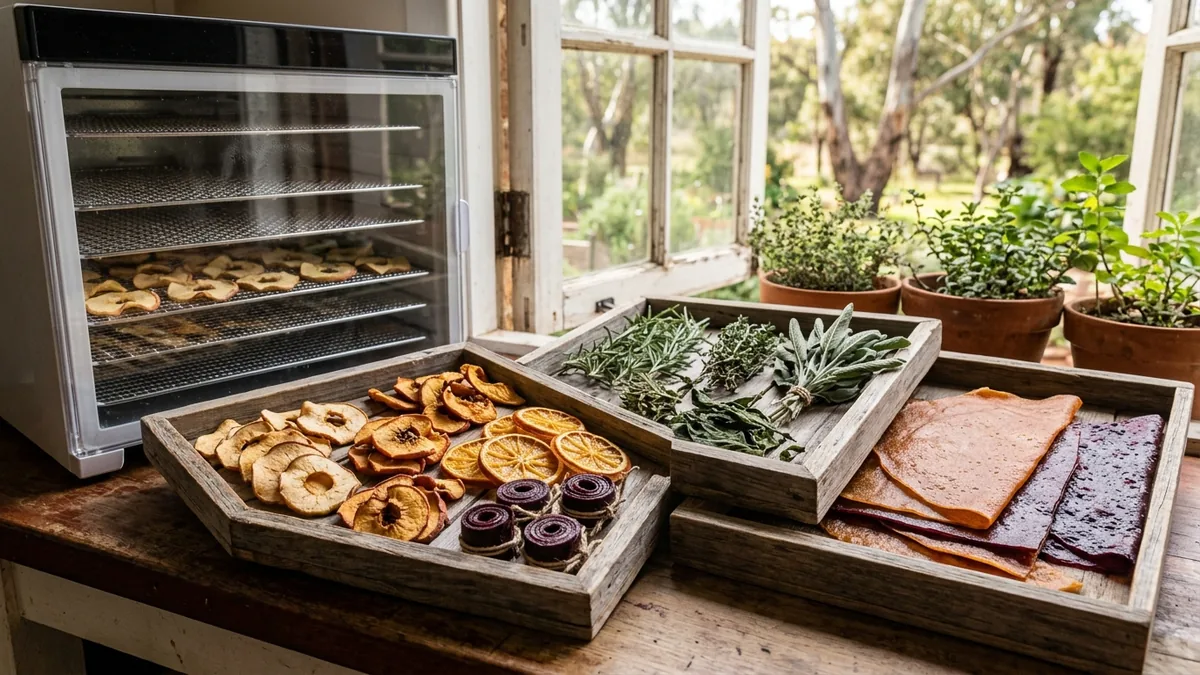
Dehydrating Food in New Zealand: Fruit, Vegetables and Herbs
In a humid country, drying is about steady heat and moving air. 60°C for fruit and vegetables, gentle heat for herbs.
Use a dehydrator, or an oven that holds 60°C with the door propped open, for fruit and vegetables. Soak cut fruit in an acid dip for 10 minutes, blanch most vegetables, and dry herbs gently at 35 to 46°C. Open-air drying needs heat and low humidity that most of New Zealand rarely gets, so it is not a reliable method here except for herbs and chillies hung indoors.
The dehydrating picker
Choose a food to see how to prepare it, the drying temperature and roughly how long it takes.
Drying times are a guide from extension testing. Humidity, the size of the pieces and your dehydrator all change them, so test the food.
Feijoas, apples and stone fruit
Autumn is drying season: feijoas, apples, pears and late plums all come at once. Slice evenly, about 3 to 6 mm, and drop the slices straight into a dip of half lemon juice and half water, or citric acid at about 5 g per litre, for 10 minutes. Colorado State University found the dip cuts bacteria such as Salmonella and Listeria during drying as well as keeping fruit pale. Dry at 60°C until leathery and pliable, with no moisture when a cooled handful is squeezed.
Vegetables
Most vegetables keep better if blanched first: carrots 3½ minutes, green beans and peas 2, silverbeet 1½, courgette slices half a minute. Capsicum, chillies, onions, corn kernels and shop mushrooms go on raw. Dry until brittle. Never dry foraged wild mushrooms: drying does not destroy the toxins of poisonous species.
Herbs
Pick herbs just before they flower, in the morning once the dew has gone. In a dehydrator at 35 to 46°C they take 1 to 4 hours. Rosemary, sage, thyme and parsley also dry well in small bunches hung inside, out of the sun. Basil and mint, with softer leaves, do better in the dehydrator during a humid spell.
Oven drying
Many ovens cannot hold 60°C; check yours with an oven thermometer. If it can, prop the door 5 to 15 cm open and expect twice the dehydrator time. Too hot, and the food cooks outside while staying damp inside.
Conditioning and storage
Condition dried fruit in loosely filled jars for 4 to 10 days, shaking them daily, and dry it longer if condensation forms. Store dried fruit airtight in a cool, dark cupboard for 6 to 12 months; dried vegetables keep about a year somewhere cool. Fruit leather lasts a month in the pantry or a year frozen.
Dried tomatoes in oil: CSIRO says properly dried tomatoes are acidic enough; anything less than fully dry, and any garlic or fresh herbs, must be acidified or kept in the fridge for a short time only.
More ways to keep the harvest in our preserving hub.
Sources we checked (October 2026): Montana State University Extension, Drying Vegetables (MontGuide, 2017); Colorado State University Extension, Drying Fruits; National Center for Home Food Preservation: Herbs, Fruit Leathers, Sun Drying; CSIRO, Preservation of vegetables and herbs in oil.
Common questions
Can I dry feijoas?
Yes. Slice them evenly, dip in lemon juice and water or citric acid for 10 minutes, and dry at 60°C until leathery.
Why did my dried fruit go mouldy?
It was not dry enough, or it skipped conditioning. Condition dried fruit in jars for 4 to 10 days and dry it longer if moisture appears on the glass.
Can I sun dry in New Zealand?
Rarely. Sun drying needs several days of about 30°C or more with humidity under 60%. Use a dehydrator or an oven that holds 60°C.
What temperature for herbs?
35 to 46°C in a dehydrator, or up to 52°C in humid weather. They take 1 to 4 hours.